

Learning how to be autistic
How do you unmask when you've never known yourself without the mask?

I’ve been writing about unmasking your creativity this week in my new book, Divergent Creatives. It’s a topic I’ve been thinking about a lot, lately.
I spent around 35 years of my life with absolutely no idea that I was neurodivergent. I just knew that I was a bit different. I didn’t seem to be able to do things the way everybody else did them, the way that was expected. I never fit in with other people. I was always just a bit different, a bit awkward, a bit of a problem.
So I spent most of my life trying to pretend to be normal. Desperately trying to be accepted. I became really good at mimicking people, so that I could blend in. Even my accent is pliable—it will go wherever suits the group. I never consciously set out to do that, it was pure instinct. I hadn’t even realised I was doing it until I started researching neurodivergence, and I learned about masking. I didn’t understand that I was putting on a mask, dressing up like a neurotypical person to avoid being rejected or attacked. My system was just trying to survive.
Now that I know about my neurodivergence, though, I can drop the mask. I can be myself. Sounds great, doesn’t it? Sounds easy. But after so many years of pretending to be whatever other person I thought might be safe in a given situation, how am I supposed to know who I am?
Here’s a little snippet from my book, Divergent Creatives, on this topic:
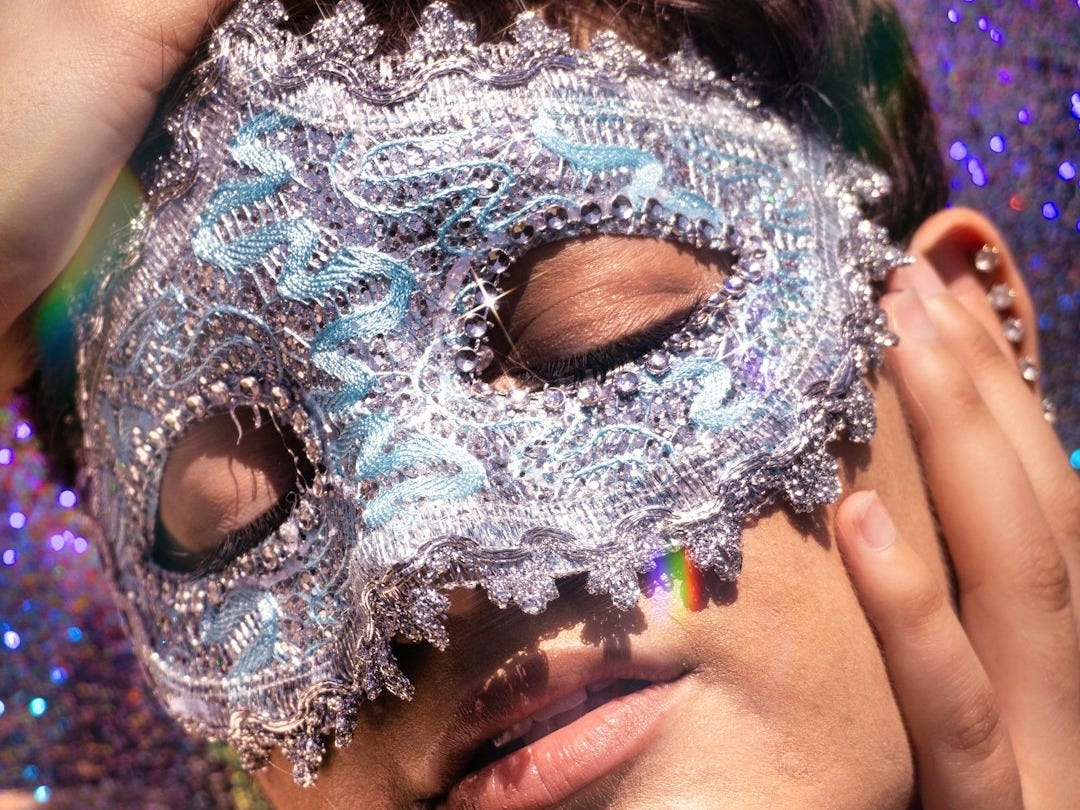
When you’ve been masking—pretending to be neurotypical, desperately trying to blend it—for most of your life, it becomes hard to separate yourself from the mask. How much of you is truly this way, and how much is this an act you’ve been putting on for the benefit of other people?
The process of unmasking, and learning who you are beneath the mask, is an incredibly long and complex one, and not one that I can really cover in this small section.
What I can do, though, is give you a few ways to think about who your artist self is, at their core, when no one is telling you how you should be doing life.
What feels uncomfortable?
As neurodivergent people (especially women and people of marginalised gender identities), we’ve been taught not to listen to our bodies and to override our own discomfort. Slowly, we need to relearn how to listen to our physical signals again.
Notice when something feels wrong. Is there a tightness in your chest? A twisting in your stomach? A knot in your throat? Your body has its own way to signal to you that you’re not in a zone that feels safe.
Keep track of what situations, or environments, or working methods trigger that response from you. If a certain approach feels wrong, it probably is wrong for you.
What if no one was watching?
Start to recognise how differently you approach a task or an activity when other people are around (or when you’re sharing your process publicly, say on social media) compared to when you’re on your own.
If you change your behaviour in front of others, that could well be a masking tactic rather than the way you would prefer to work.
Who is telling you to do that?
Get curious about the different elements of your process. Question why you do something the way you do. Experiment with doing it differently.
If you hear a voice in your head telling you that you have to do it that way, approach it with interest rather than judgement. Whose voice is saying that? Where have you heard that before? Is it really true? What would happen if you didn’t do it that way?
Allowing yourself to play with rules and experiment with your process will let you test out what really does work for you, and what is actually a self-imposed restriction that is needlessly holding you back.
What did you used to love?
Think back to what you used to passionately enjoy, that you put away because you thought it wasn’t a valid interest or it was a waste of time or other people would judge you for it.
You don’t necessarily have to take it up again if you’ve moved on, but what does it tell you about yourself?
As a teenager, I was obsessed with the occult. I read Tarot cards and I had about a million candles to make spells with. I put all that away because I thought it wasn’t “serious” enough when I was in my 20s. Recently, I’ve fallen back in love with it all again, and realised there was a part of me that is interested in the dark shadows of life and is deeply connected to nature that I had been shutting away. Letting her back out of the closet has taken my creative practice in a new direction that I’m very much enjoying! I’ve been working with mythology (a topic I was fascinated by as a child) a lot in my writing and my art, and discovering art techniques that integrate magick practices with nature. So much fun (for me, anyway).
Who do you feel safe with?
We usually mask to protect ourselves from criticism or judgement or aggression. Finding people who you feel comfortable enough to be yourself with is important, because you can’t unmask if you don’t feel safe.
To work creatively as your authentic self, joining a community (in person or online) that understands and supports neurodivergent creatives could be really valuable. Not only will you feel more comfortable to show up as yourself, but you can listen to ways other people work and you might find some tips you can try out in your own practice.
Masking isn’t necessarily bad
We talk about unmasking because we want to unlearn behaviours that we’ve adopted purely for the benefit of other people if they’re stifling our true selves. But we don’t have to unmask everything.
Some masking behaviours can be helpful. We do, all of us, neurodivergent and neurotypical alike, have to get on with other people in a collaborative society, so adapting our natural impulses to suit others isn’t always a bad thing. But that should go both ways—we can also, usually, adapt to make space for people’s authentic behaviours, like stimming, or wearing noise-cancelling headphones, or chatting about their special interests even if it’s not someone we’re personally that into.
You don’t need to beat yourself up for masking, or think that you’re being somehow false or inauthentic if you mask in certain ways. You’re adapting to the environment in the best way that suits you, and that’s entirely sensible.
If, however, masking behaviours are causing you problems and stopping you from living life in a way that suits you (and, in this case, making your art in the best way for you), that’s when it’s a good idea to find ways and spaces that you can safely unmask.
Remember, it’s always a good choice to get professional support if you would find that helpful.
If you want to read more about being your full self as a neurodivergent, disabled or outside-the-box creative, pre-order Divergent Creatives now!
